Below are the sustainbility goals for the entire global Yokogawa network of companies, of which Yokogawa Marex is a part.
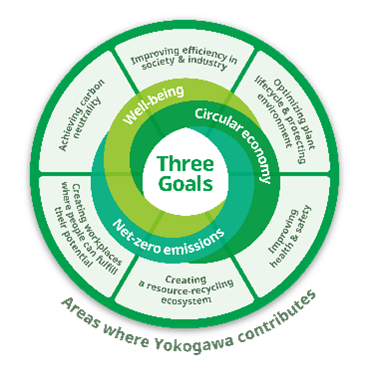
For Yokogawa, sustainability and business activities are inseparable. Under Yokogawa’s Purpose, “Utilising our ability to measure and connect, we fulfill our responsibilities for the future of our planet,” Yokogawa has set the sustainability goals as “Three Goals” for the society we aim to achieve by 2050, and continues to make persistent efforts to realise a sustainable society.
Six contribution areas
Based on the results of the materiality analysis, we have set six contribution areas in order to achieve the sustainability goals of the “Three Goals,” which are the vision for society toward 2050.
GS2028 focuses on business activities that contribute to six areas, aiming to expand contributions to society and environment and achieve dramatic business growth.
Six contribution areas and priority issues
| Contribution area | Priority issue |
| Achieving carbon neutrality | Reducing GHG emissions and enabling the transition to affordable, reliable and sustainable forms of energy |
Improving efficiency in society & industry
| Optimising production, enabling autonomy and facilitating the efficient use of resources and energy through DX
|
Optimising plant lifecycle & protecting environment
| Supporting both the long-term optimal operation of plant assets and the reduction of their environmental footprint
|
Improving health & safety
| Promoting life-related innovation and improving safety in plants and communities
|
Creating a resource-recycling ecosystem
| Fostering the development of the bioeconomy and a circular economy
|
| Creating workplaces where people can fulfill their potential | Establishing an equal opportunity workplace where employees can be treated with dignity and fulfill their potential
|
Read more: Contribution areas and targets
Read more: Environmental Targets and Achievements
We will promote the expansion of our contribution to society and environment through medium to long term “social impact indicators.” In addition, we will promote business growth through “business activity indicators” set for each business and “sustainability transition sales,” which measure the business volume of growth areas that contribute to the sustainability of the Group.
Sustainability transition sales and focus area
In the GS2028, we will measure the sustainability transition sales amount in areas expected to grow and contribute to sustainability. We have set focus areas that contribute to sustainability transitions for each business segment and have already started activities. As we grow our business, we will increase the ratio of sustainability transition sales amount from the current 40% to 50% by fiscal year 2028.